
The National Academy of Medicine (NAM) Scholars in Diagnostic Excellence is a collaborative program designed to develop a cadre of leaders who can drive implementation of national strategies to raise awareness of diagnosis in medicine, support diagnostic excellence, and reduce diagnostic errors.
The program supports participation of up to 6-10 scholars in a one-year, part-time remote experience that enhances their knowledge and skills in diagnostic quality and safety, and accelerates their career development as national leaders in the field. Awardees benefit from a structured online curriculum, cohort learning activities, professional networking and mentorship opportunities, and a $35,000 grant with an additional $5,000 domestic travel funds.
Now in its fifth year, NAM Scholars have presented at national meetings, received academic promotions, and other grants in diagnostic quality and safety.
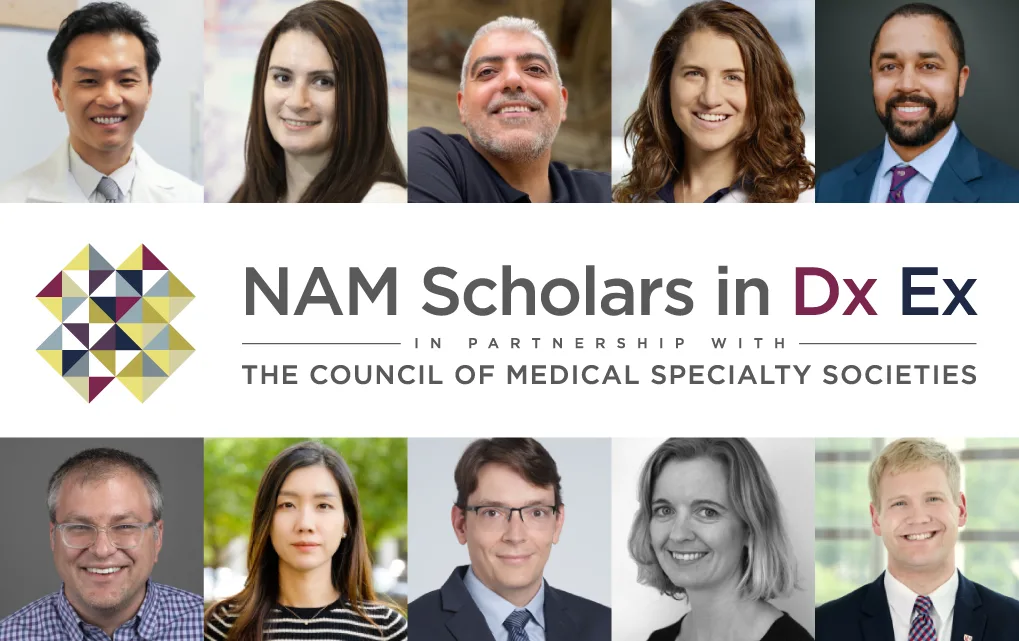
2026 NAM Scholars in Diagnostic Excellence
Dania Daye, MD, PhD
Associate Professor of Radiology; Vice Chair of Practice Transformation; Director, Center of High Value Imaging, Department of Radiology, University of Wisconsin School of Medicine and Public Health, Madison, Wis.“Multi-Agentic AI System for End-to-End Management of Incidental Findings in Diagnostic Imaging”Ahmed Hassoon, MD, MPH
Assistant Research Professor, Department of Epidemiology, Johns Hopkins Bloomberg School of Public Health, Department of Neurology, Johns Hopkins Medicine, Department of Computer Science, Johns Hopkins Whiting School of Engineering, Baltimore“The Patient Advocate to Empowering Patients in the Diagnostic Process: A Safety Framework and Modus Operandi for Agentic AI-Mediated Error Interception”Shuhan He, MD
Emergency Physician and Clinical Informatician, Department of Emergency Medicine, Massachusetts General Hospital, Boston“Diagnostic Safety by Design: Clinician-Centered Redesign and Multi-Site Deployment of a Digital Uncertainty-Reduction Tool for Emergency Medicine”Julius Oatts, MD, MHS
Attending Physician and Associate Professor, Department of Ophthalmology, Children’s Hospital of Philadelphia / University of Pennsylvania Perelman School of Medicine, Philadelphia“Improving Retinopathy of Prematurity Diagnostic Verification and Predictive Modeling Using a Novel Image Grading Score”Andrei S. Purysko, MD, FSAR
Section Head, Abdominal Imaging, Diagnostics Institute, Cleveland Clinic, Cleveland, OH; Associate Professor of Radiology, Cleveland Clinic Lerner College of Medicine, Cleveland Clinic, Cleveland“Improving Prostate Cancer Diagnosis Through Standardized Prostate MRI Image Quality Assessment”Adam Rodman, MD, MPH
Director or AI Programs, Carl J Shapiro Institute for Research and Education, Beth Israel Deaconess Medical Center, Boston“Laying the Groundwork for an Effective, Evidence-Grounded LLM-Based Second Opinion Trigger System for High-Risk Hospitalized Inpatients”Cory Rohlfsen, MD
Associate Professor, Department of Internal Medicine, University of Nebraska Medical Center, Omaha, Neb.“Can Diagnostic Excellence Be Measured?”Lucy Schulson, MD, MPH
Assistant Professor, Boston University Chobanian & Avedisian School of Medicine; Attending Physician, Section of General Internal Medicine, Boston Medical Center physician, Immigrant and Refugee Health Center, Boston“Bridging Diagnostic Gaps: Using AI to Identify Missed Heart Failure with Preserved Ejection Fraction Diagnosis to Improve Diagnostic Equity in Ambulatory Care”Kathleen E. Walsh, MD, MSc
Director, Healthcare Quality and Safety Research Program; Director, Harvard-Wide Pediatric Health Services Research Fellowship, Division of General Pediatrics, Boston Children’s Hospital, Boston“Improving Communication of Pediatric Diagnostic Uncertainty with Outpatient Families”Yize Zhao, PhD
Associate Professor, Department of Biostatistics, Yale School of Public Health, New Haven, Conn.“Dynamic Diagnostic Surveillance: An Equity-Centered, Uncertainty-Aware Framework for Timely ADRD Diagnosis from EHRs”
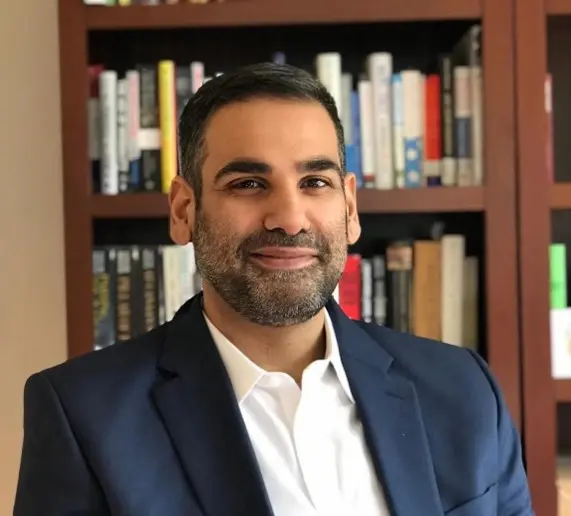
This is an incredible program hosted by a wonderful community of brilliant people, and both the curriculum and networking opportunities offered by the program are built with deep intentionality towards helping you grow the impact of your work.
I can’t endorse this program strongly enough; if you have an interest in diagnostic excellence, you should absolutely apply.
Staff Ophthalmologist, Veterans Affairs VISN 23 Clinical Resource Hub
Audience:
This program supports individuals with a focus on diagnosis-related work, including but not limited to:
- Physicians and advanced practice clinicians
- Quality experts, informaticians, and researchers
Strong preference is given to candidates whose proposed program objectives advance specific recommendations of the 2015 National Academies of Sciences, Engineering, and Medicine consensus report, Improving Diagnosis in Health Care, when applicable.
Value:
Investing in national diagnostic leaders increases the integrity and visibility of diagnostic excellence, and helps to build future diagnostic programs, faculty, and mentors. The program is a part of CMSS’ commitment to career development of emerging leaders, and to shared learning and collaboration among specialty societies.
Acknowledgement
This program is funded by the Gordon and Betty Moore Foundation, with additional funding from the Coordinating Center for Diagnostic Excellence (CODEX) at the University of California, San Francisco, this collaborative program between the National Academy of Medicine (NAM) and the Council of Medical Specialty Societies (CMSS) is designed to develop a cadre of leaders who can drive implementation of effective strategies to raise awareness of diagnosis in medicine; support diagnostic excellence, and reduce diagnostic errors at the national level.

Contact
Julia Peterson, CMSS COO
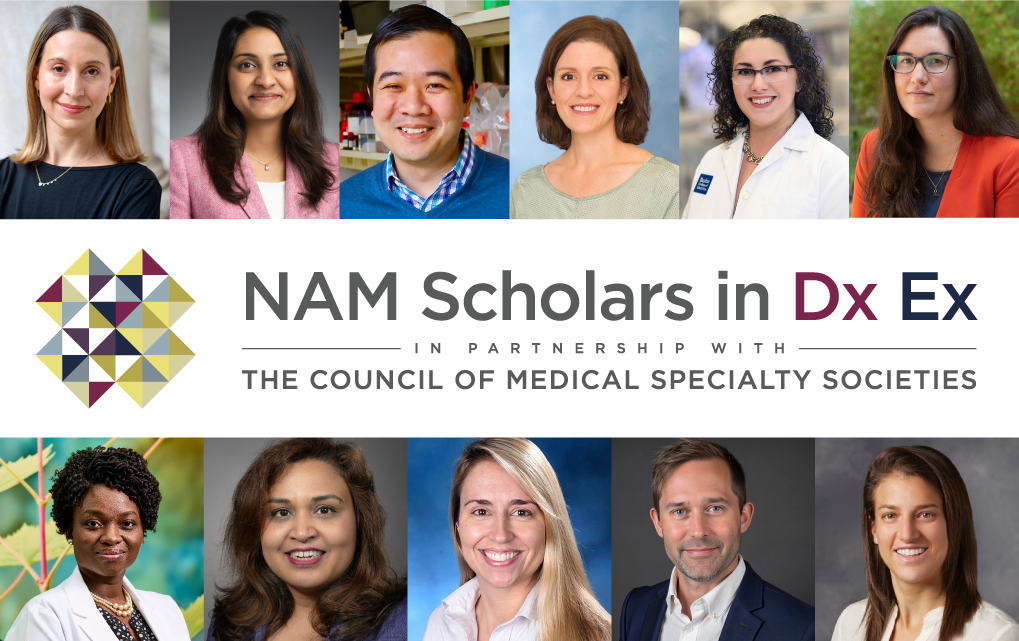
2025 NAM Scholars in Diagnostic Excellence
Emily Abdoler, MD, MAEd
Clinical Associate Professor of Medicine, Department of Medicine, Division of Infectious Diseases, University of Michigan Medical School/Veterans Affairs Ann Arbor Healthcare System, Ann Arbor“REFLECT: Reflective Exercises for Learning diagnosis while Engaged in Clinical Training”Bubu A. Banini, MD, PhD
Assistant Professor of Medicine, Section of Digestive Diseases, Yale School of Medicine/Yale New Haven Health System, New Haven, Conn“Improving Diagnosis of Steatotic Liver Diseases through an Artificial Intelligence (AI)-Based Practical and Scalable Approach”Andrea Bradford, PhD
Associate Professor, Department of Medicine, Baylor College of Medicine, Houston“Implementing Strategies for Achieving Diagnostic Excellence in Mental Health”Nina Gold, MD, MBI
Director of Prenatal Medical Genetics, Department of Pediatrics, Massachusetts General Hospital, Boston“Identification of Undiagnosed Adults at Risk for Treatable Genetic Disorders”Katherine E. Goodman, JD, PhD
Assistant Professor, Departments of Epidemiology and Public Health, University of Maryland School of Medicine, Baltimore“Unlocking’ Patient Symptoms with Generative AI to Promote Diagnostic Excellence”Snigdha Jain, MD, MHS*
Assistant Professor, Section of Pulmonary, Critical Care, and Sleep Medicine, Department of Internal Medicine, Yale School of Medicine, New Haven, Conn“Improving Diagnostic Decision-Making for Weaning Sedation and Ventilator Support in Critically Ill Older Adults: An Electronic-Health Record Based Approach”Aparna Kulkarni, MBBS, MSc
Director of Quality Improvement and Outcomes, Heart Center at Cohen Children’s Medical Center at Northwell Health; and associate professor of pediatrics, Donald and Barbara Zucker School of Medicine, New Hyde Park, N.Y.“Comprehensive Needs Identification and Enhanced Care Coordination to Support Access and Achieve Diagnostic Excellence in Echocardiogram Assessments of Fetuses with Congenital Heart Disease”Freddy T. Nguyen, MD, PhD
Director of MIT Catalyst Scholars Program, Office of Innovation and Institute for Medical Engineering and Science, Massachusetts Institute of Technology, Cambridge“Developing a Patient-Centered Framework to Guide Medical Diagnostic Technology Development”Claire O’Hanlon, PhD, MPP
Policy Researcher, Department of Behavioral and Policy Sciences, RAND Corp., Santa Monica, Calif.“Understanding Patient Delays in Cancer Diagnosis”Lauren M. Shapiro, MD, MS
Assistant Professor, Department of Orthopedic Surgery, University of California, San Francisco“Minimizing Diagnostic and Treatment Delays in Wrist Fracture Care: A Multicenter Mixed-Methods Approach”R. Andrew Taylor, MD, MHS
Vice Chair for Research and Innovation, and Professor, Department of Emergency Medicine, University of Virginia School of Medicine, Charlottesville“Bringing Diagnostic Quality Evaluation in the Emergency Department to Scale Through Artificial Intelligence”
2027 Call for Applications
Call for Applications Opens
Applications Due
Finalists Notification
Scholars Notification
Our partnership with NAM enables CMSS to annually support a remarkable cohort of scholars in diagnostic excellence across a wide range of specialties.
– Helen Burstin, MD, MPH, MACPCMSS Chief Executive Officer